
WIT Release Versus Placement
The Women in Transition Center is an ECSD minimum-security and pre-release facility in Salisbury. It serves women through counseling, education, community assignments, and preparation for return to the community. Arrival at WIT from another sheriff site is an internal custody change. A community assignment can occur under authorization while the person remains subject to ECSD rules. Electronic monitoring may also describe a controlled placement rather than a complete discharge.
The final event can take several forms. A sentence may expire. A court may order release to probation. The Parole Board may authorize parole where the sentence permits it. ECSD may transfer the person to another authority, or a new hold may affect the destination. The Offender Management System release date and type answer what ECSD recorded. The originating docket explains the court’s order. A supervising agency confirms whether legal oversight continues after physical release.
| WIT event | Custody meaning | Confirmation |
|---|---|---|
| Transfer into WIT | ECSD custody continues | OMS placement and transfer history |
| Community assignment | Authorized activity, not final release | Program status and final OMS event |
| Electronic monitoring | May remain a restrictive status | Court or ECSD terms |
| Final community release | ECSD custody ends | Release type, docket, supervision record |
Confirm a WIT Release
ECSD publishes no verified current jail roster or recent-release list. Absence from a public search does not establish that WIT released a named woman. Begin with the correct custodian, then seek an affirmative release event. Full name, date of birth if known, approximate custody dates, Essex docket number, and ECSD booking number can help distinguish the right record.
- Confirm that WIT, not Barnstable or another facility, was the person’s last physical ECSD placement.
- Request the ECSD OMS booking and release history, including the final release date, release type, releasing facility, and receiving agency.
- Use the MassCourts docket by exact docket number to read sentence, presentence custody time, probation, bail, warrants, and later orders.
- If the record shows a transfer, contact the receiving authority rather than treating the transfer as freedom.
- For parole or probation, confirm the active office and terms through the proper board or court channel.
The Essex County released inmates search provides the wider custody-source sequence when a WIT record points to another county, MA DOC, federal custody, or immigration custody.
WIT Release Record Requests
The ECSD public-record request page is the official route for an existing release entry. Ask for public and nonexempt parts of one person’s OMS booking and release history within a defined period. Useful fields include booking number, admission date, WIT placement, releasing facility, actual release date and time, release category, receiving authority, and the public court or mittimus reference. A mittimus is the court document directing custody.
Electronic delivery is best. The request should identify an existing record rather than demand a custom list or new analysis. Massachusetts law generally requires production or a written response within ten business days, subject to lawful fees, exemptions, and an agency production plan. Medical facts, private identifiers, victim material, active investigative details, sealed records, juvenile data, and security information may be withheld. An agency should separate releasable facts where possible.
WIT and ECSD Records
Women in Transition Center
197 Elm Street
Salisbury, MA 01952
978-750-1900 ext. 3728
ECSD Records Access Officer
Gretchen Grosky
P.O. Box 807, Middleton, MA 01949
978-750-1900 ext. 3361
ggrosky@essexsheriffma.org
The WIT extension serves direct facility routing. The central RAO handles the written ECSD release-record request.
WIT Release Program Facts
ECSD’s 2024 annual report gives WIT an average daily population of 17, including three people in the Electronic Monitoring Program. These are annual operating measures, not a current head count or rated capacity. They show the site’s small, specialized role and the need to read status carefully. A person counted in an electronic monitoring program may be outside a secure building but still subject to a controlled legal arrangement.
Review the official Women in Transition Center source before the facility capture below.
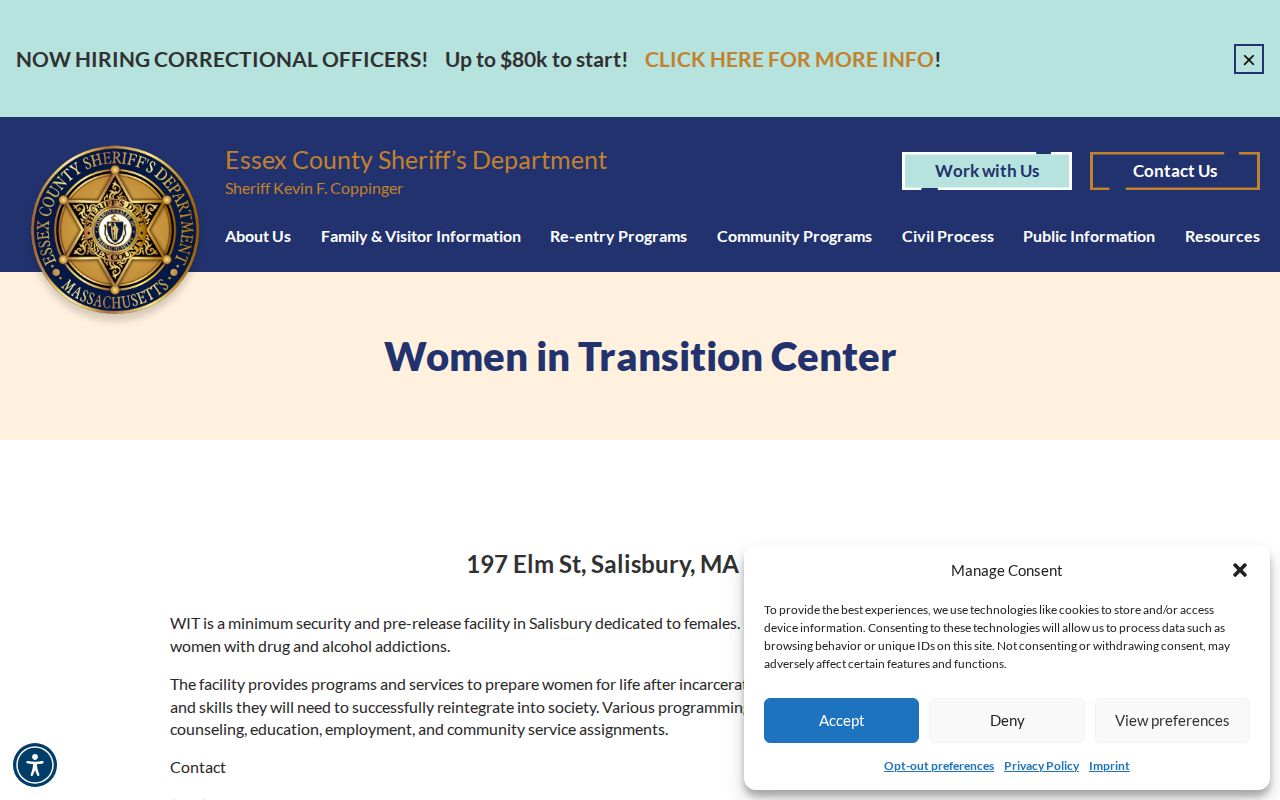
The official page confirms WIT’s minimum-security and pre-release purpose. It does not display a public release result for a named person.
WIT Release and Supervision
WIT’s focus on reintegration does not determine which legal status follows. Probation is a court order that can begin after incarceration or as part of a sentence. Parole is release from a sentence under Parole Board jurisdiction, with conditions continuing in the community. An electronic monitoring placement may arise from a court or agency arrangement. These terms should not be merged into the word “released.”
Match the final OMS release type to the docket. If probation follows, the court record identifies the case and terms. If parole follows, use the Massachusetts Parole Board route and verify the assigned office because residence can control supervision routing. If neither follows, ask whether the ECSD entry reflects sentence expiration or another discharge category. A court order can authorize release before the jail finishes processing it, so the actual ECSD date remains important.
Release preparation records can explain the plan without proving that it occurred. Counseling, education, and community assignments are part of WIT’s documented role. They may support a transition, but no one program entry supplies the final custody date. Ask whether the person completed the placement, returned to another ECSD site, entered electronic monitoring, or received a final release type. Then connect that answer to the court order and supervising office.
Timing also matters when sources appear to disagree. A docket entry can show that a judge authorized release before ECSD completed the physical process. A supervision record may begin after the final sheriff event. Place each dated entry in order and note which agency created it. That method preserves the difference between legal authority, physical release, and supervision in the community.
- Pre-release
- A custody stage aimed at preparing for return, not proof of discharge.
- Probation
- Court-ordered supervision in the community.
- Parole
- Conditional community release under Parole Board jurisdiction.
- Transfer
- A move to another site or authority while custody continues.
WIT Release Custody Boundaries
ECSD has stated, under the Massachusetts Lunn decision, that state officials cannot extend custody beyond the otherwise lawful release point solely because of a federal civil immigration detainer. That does not make WIT an immigration facility. It also does not prove community entry. Federal officers may act separately, and another valid warrant, sentence, or custody order can govern the destination.
If the WIT release entry names another authority, search that custodian independently. ICE has its own locator. MA DOC has a separate state-prison path. Barnstable may be the physical custodian for an Essex placement. The ECSD record proves the change in sheriff status, while the other source proves what followed. Preserving that boundary prevents a transfer from being mislabeled as a release.
WIT in Essex Releases
WIT is distinct from both Middleton and the Lawrence center. Middleton holds mixed pretrial and sentenced populations in a medium-security setting. Lawrence is a lower-security step-down center with its own long institutional history. WIT is the women’s minimum-security and pre-release setting in Salisbury. The network can move a person between locations before the last sheriff custody event.
For Essex women, the map also includes Barnstable County Correctional Facility as an outside-county serving location. Failure to locate a woman at Middleton or WIT may reflect that placement, not release. Ask for the complete ECSD transfer and release sequence. The last dated custody event, the physical custodian’s record, and the Essex court order together show far more than the name of the last building.
A chronological request is useful when more than one site appears. Ask ECSD for the admission, each transfer date, the releasing facility, and the final release type. If Barnstable held the person during part of the period, request that physical custodian’s responsive entry as well. A return from Barnstable to WIT is another custody move. It is not proof that the person entered the community between the two placements.
The 2024 operating measure offers one more reason for precision. WIT’s average daily population included people in the Electronic Monitoring Program. That count shows a legal status can extend beyond the secure site, but it does not disclose the terms for a named person. The individual order and OMS record control. Do not infer discharge from a program label, an outside appointment, or a change in where the person sleeps.
For a final check, compare the ECSD date with the court’s disposition and any supervision start. If those dates differ, ask the creating office what each date represents. One may be the legal order date, another the physical processing date, and another the start of probation or parole. Naming each event prevents a false single-date conclusion.
Note: WIT’s program role adds context, but only the final custody record and legal order establish the release.
Public Record Search
Sponsored Results