
Essex County Release Records
A release is the end of one legal status or one agency's custody. It does not always mean the person walked into the community. The Massachusetts admissions and releases system includes bail, court release, parole, probation, sentence discharge, transfer, release to another criminal justice agency, and a change of status while a person remains incarcerated. For Essex County released inmates, the receiving authority and the next legal status matter as much as the word “release.”
Middleton holds both pretrial and sentenced people. A pretrial detainee may leave after bail, recognizance, dismissal, a court order, or time served. A sentenced person may reach the end of a house-of-correction term, earn a lawful deduction, enter parole or probation, or move to another authority. A move from Middleton to Lawrence or Salisbury is still Essex County Sheriff's Department custody. The same is true when an Essex woman is housed at Barnstable. Confirm the event before treating it as freedom.
- Discharge
- The end of custody or sentence status recorded by the responsible agency.
- Transfer
- A move from one facility or authority to another, not a community release.
- Parole
- Conditional release from a sentence under Massachusetts Parole Board jurisdiction.
- Probation
- Court-ordered supervision that may begin when incarceration ends.
How Essex County Custody Ends
The official release type tells what happened and which source should be checked next. A court order may authorize release, but ECSD records when the jail completed its part. A hold, warrant, or transfer can change the destination even after one case ends.
| Release type | Meaning | Next check |
|---|---|---|
| Bail or recognizance | Pretrial custody ends for that case, subject to other holds. | ECSD release entry and court docket |
| Time served or court release | A disposition or order ends the custodial basis. | Docket order plus actual release time |
| Parole or probation | Custody may end while supervision continues. | Parole Board record or court probation order |
| Sentence discharge | The applicable sentence ends after lawful credits. | Custodian's discharge certificate or OMS entry |
| Transfer | Custody passes to another facility or authority. | Name and locator of the receiving agency |
| Home confinement | The person is outside a jail but remains under a restrictive status. | Court order and supervising agency |
Note: A booking photograph or property receipt can identify a booking, but neither document proves that a lawful release occurred.
What Essex Release Records Show
ECSD's Offender Management System is the key county source. The State Auditor reports that it stores booking and release details for each admission. A focused request should seek public and nonexempt fields, not private identifiers. The release date and release type are central, while the booking number ties the result to the right admission.
| Field | What it shows |
|---|---|
| Full identity | The person tied to the ECSD admission |
| ECSD booking number | The unique number for that admission |
| Booking or admission date | When the custody episode began |
| Releasing facility | The ECSD site that processed the event |
| Release date and time | When ECSD recorded the change |
| Release type | Bail, parole, sentence completion, transfer, or another coded event |
| Court or mittimus reference | The legal authority connected to custody |
| Receiving authority | Where custody went after a transfer, if maintained |
A name missing from a current source is not a release record. Ask for an affirmative event, date, type, and receiving authority.
Request Essex County Release Records
Send a reasonable, date-bounded request to ECSD's Records Access Officer. Identify the person, known date range, and the exact existing fields sought. Electronic delivery helps limit copying cost. Private identifiers, medical material, victim information, juvenile records, and security-sensitive content may be redacted or withheld.
- Give the full name and any safe distinguishing information, plus the approximate booking or release dates.
- Ask for the public portions of the OMS booking and release history, including booking number, admission date, releasing facility, release date, release type, and receiving agency.
- Request the related public mittimus or release authority and state that electronic records are preferred.
- If the response is delayed or denied, read the cited exemption and use the Massachusetts Supervisor of Records process when appropriate.
Gretchen Grosky
20 Manning Avenue, P.O. Box 807
Middleton, MA 01949
978-750-1900 ext. 3361
ggrosky@essexsheriffma.org
Under M.G.L. c. 66, §10, an agency ordinarily produces records or gives a written response within ten business days. State-agency rules generally provide the first four hours of qualifying staff time without charge, cap later staff time at $25 per hour absent approval, and cap standard black-and-white copies at five cents per page. A sheriff may apply the law to the facts of a specific request.
A narrow request is easier to search and review than a demand for every record about a person. If the booking number is unknown, give an approximate admission date, the court division, or another safe identifier. Ask the officer to explain which record series was searched and whether a transfer destination is kept in the responsive OMS fields. That detail can resolve an apparent release without exposing private information.
Essex Release Record Retention
Online visibility and legal retention are not the same. Massachusetts schedules keep many correctional records long after a name disappears from a public-facing system. Commitment and discharge logs and booking records may be retained for 25 years after final release; personal-property records have a shorter schedule; work-release and parole files have their own periods. The current schedule also lists house-of-correction records for 25 years after release.
Ask the ECSD Records Access Officer which series governs the requested OMS entry. Sealing can remove a case from ordinary public discovery, and expungement is a narrower process that can destroy covered government records when granted. Under M.G.L. c. 276, §100A, ordinary conviction sealing periods generally run from disposition or release, whichever is later, subject to exclusions. A missing public docket may therefore reflect access rules rather than proof that no case or release existed.
Essex County Release Event Counts
ECSD's 2024 annual report recorded agency activity across Middleton, Lawrence, and the Women in Transition Center. The figures describe events and operating population, not a public list of unique people who entered the community.
The release count included safekeep, pretrial, and sentenced categories. One person can have more than one legal status or event, and some release codes reflect transfers rather than community discharge. Use the individual OMS release type to understand a specific record.
When Essex Bail Is Processed
Essex offers a precise operational bail route instead of a recent-release feed. The ECSD bail instructions say processing occurs nightly at 8 p.m., and the person posting bail must arrive by 6:30 p.m. Records at extension 3400 provides the amount and clerk information. The payer must be at least 18 and present valid photo identification.
A cashier's check or money order is accepted, and cash is allowed up to $5,000 under the published instructions. These facts do not promise a physical exit at a set minute. A warrant, detainer, new court direction, or incomplete paperwork can prevent or delay release. The OMS event and court docket remain the proof that ECSD custody actually ended.
Find Essex County Released Inmates
Start with the custodian, not the county where the arrest happened. ECSD holds people at Middleton and its pre-release sites, while Barnstable now holds some Essex women. MA DOC covers state prisoners. BOP, ICE, and the U.S. Marshals Service are separate federal systems. A blank result in one source says nothing about the others.
- Identify the facility or agency that last held the person.
- Use a live locator only to confirm current custody, and record the source and date checked.
- Seek an affirmative release event from ECSD, DOC, BOP, or ICE rather than relying on disappearance.
- Read the exact MassCourts docket for the order, sentence, probation, warrants, and later changes.
- Check parole or probation only when the record shows supervision may follow.
- Resolve every transfer by naming and checking the receiving authority.
The same-day county situation is covered on the Released Last 24 Hours page, but ECSD currently publishes no rolling list. For one named person, the ECSD release record plus the criminal docket is the strongest county combination.
Essex State Release Search
The official MA DOC locator instructions send users to VINELink and require a full first and last name or commitment number. The page says only Massachusetts Department of Correction participates in Massachusetts VINE. It must not be used as proof about a person held only by ECSD.
| Search input or field | Use |
|---|---|
| Full first and last name | Basic public lookup input |
| Commitment number | Best way to distinguish similar names |
| Feeding agency | Confirms the record is from MA DOC |
| Status and facility | Shows the current source's custody information |
| Exact date label | Must be preserved as displayed, not renamed |
The official locator is framed around someone housed in state prison and does not promise a permanent discharge archive. If a released status remains visible, note its update time and confirm the actual date through DOC records. If nothing appears, report only that the person was not found in the current MA DOC/VINELink search.
The official instructions below show the MA DOC route and its coverage limits.
View the Massachusetts prison locator instructions.
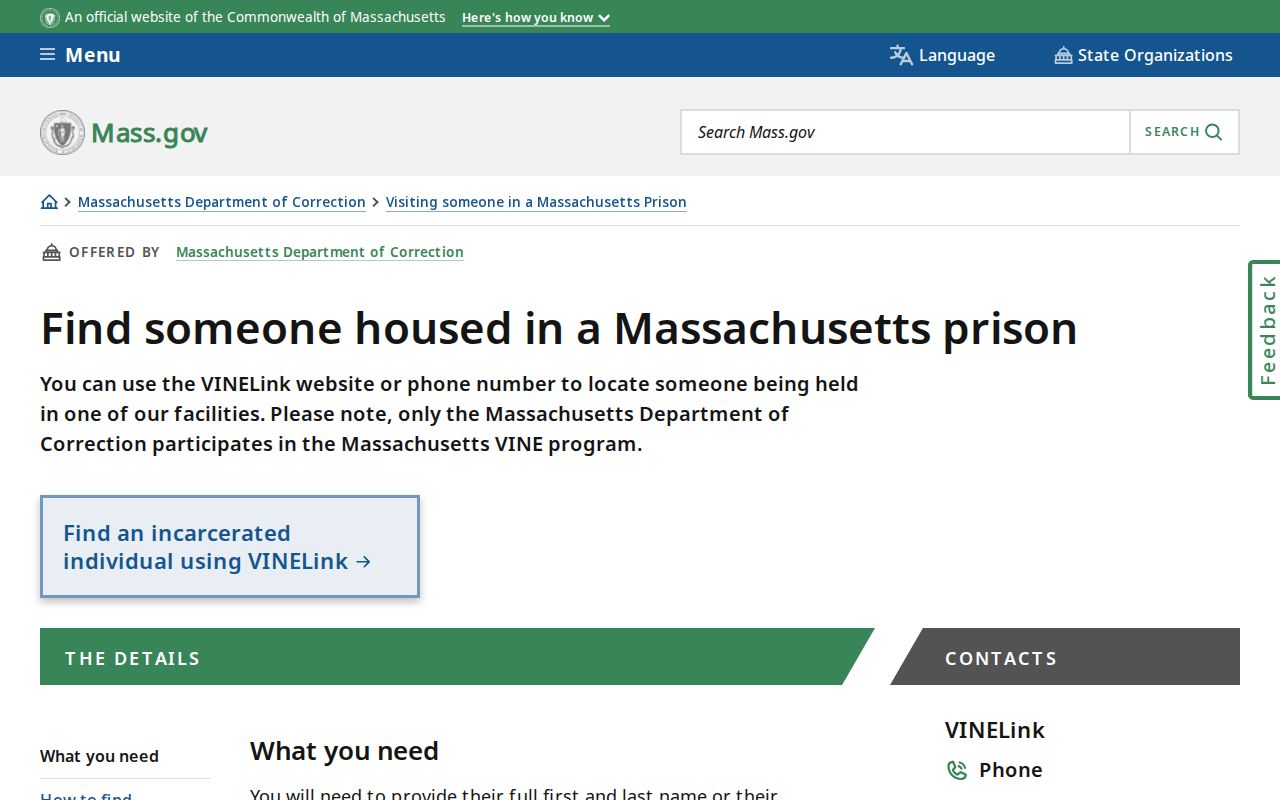
This source is useful for state prisoners, while county releases still require ECSD and court confirmation.
Essex Release Orders in Court
Remote Massachusetts criminal docket access generally requires the exact docket number. In MassCourts, select the correct department, division, and location, then enter the number with its leading zeros, spaces, and capitalization. Review bail, recognizance, dismissal, sentence, jail credit, time served, probation, stayed or vacated orders, warrants, and later violations.
The clerk holds the official public court record. Essex Superior Court's First Session sits in Salem, while other trial and probation work can route between Salem and Lawrence under the county protocol. District Court location depends on the municipality. A docket may show legal authority to release, but it cannot establish the moment a jail processed the exit. Match it to the ECSD or DOC event.
Essex Release Supervision Checks
Parole comes from the Massachusetts Parole Board; probation comes from a Trial Court order. Massachusetts has no public list of every parolee or probationer. Public life-sentence decisions can show a parole vote, but a grant is conditional authority rather than proof that a release permit was executed that day. The originating docket is the main public route for a probation disposition.
Parole Region 3 is in Lynn, yet office assignment follows the approved release address rather than the county of conviction alone. Central Office can identify the proper region. The Essex parole and probation record page explains the authorization route, court records, and local office limits.
Essex Release Support in Lynn
ECSD's Supporting Transitions and Reentry program operates community sites in Lynn and Lawrence. STAR accepts many referral routes, including self and family referrals, and offers case management, clinical groups, education, and connections to services. It may serve people returning from county or state custody.
STAR participation is not proof of when or where someone was released. Region 3 parole is co-located at the Lynn address, which makes the site a local reentry and supervision hub, but the two functions remain distinct. Use the custodian's release record for the date and the supervising agency for the conditions that follow.
Property After Essex County Release
Custody can end before every personal matter is settled. ECSD instructs released people to call extension 3402 about account funds. Funds are released on weekdays from 8 a.m. to 4 p.m. Property pickup at Middleton runs weekdays from 8 a.m. to 9 p.m., with a separate directory extension.
The post-release funds instructions and property pickup instructions are operational services, not release proof. M.G.L. c. 127, §3 requires jail and house-of-correction officials to record prisoner money and property and deliver it to the person or their order on discharge, subject to the statute. Keep receipts separate from the OMS release entry.
Federal and ICE Release Checks
The BOP Inmate Locator covers federal inmates from 1982 onward. A result may display name, register number, descriptors, release date, and location. “Released” or “Not in BOP Custody” means the person is no longer held by BOP, but another agency may have custody and federal supervision may continue.
The ICE Online Detainee Locator includes people now detained and some people released from ICE custody within the prior 60 days. Search it separately. An ECSD statement applying the Massachusetts Lunn rule explains that state officers cannot extend custody solely on a federal civil immigration detainer after the lawful state release point. Federal officers may still act at or after that point, so ECSD release and federal custody are two different questions.
USMS has no public historical released-person locator comparable to BOP. Use the federal docket, BOP after designation, and the agency's records process where lawful. Never turn a missing federal result into a claim of community freedom.
Where Essex Release Status Appears
Each system answers a narrow question. Checking them in order prevents a county transfer from being mistaken for a state discharge or federal release.
| System | What it can confirm | Main limit |
|---|---|---|
| ECSD OMS record | County booking, date, type, and receiving agency | Available by focused records request, not public feed |
| MassCourts | Release authority, sentence, disposition, and probation | Does not prove exact physical exit time |
| MA DOC/VINELink | Current participating state-prison status | Not a verified ECSD feed or permanent archive |
| BOP locator | Federal custody and released status | Does not end other custody or supervision |
| ICE ODLS | Current and limited recent ICE custody | Recent-release window is limited |
Essex County Release Facilities
The Essex custodial network includes distinct adult and juvenile routes. Middleton is the primary county jail and house of correction. Lawrence and Salisbury are ECSD pre-release sites, so an internal move there is not discharge. Barnstable physically holds some Essex women. Northeast Youth Service Center is a DYS juvenile facility and is not part of the adult public-search chain.
- Middleton Jail & House of Correction: pretrial and sentenced adult custody.
- Essex County Pre-release and Re-entry Center: lower-security step-down custody in Lawrence.
- Women in Transition Center: minimum-security and pre-release custody in Salisbury.
- Barnstable County Correctional Facility: physical custodian for some Essex female placements.
- Northeast Youth Service Center: confidential DYS juvenile detention and treatment channels.
Middleton opened in 1991. The Lawrence site began as an 1869 reform school and entered ECSD in 1976. Those histories show why facility names and legal custody must be read with care: a move within the network can look like a departure while the person remains confined.