
Essex County Release Date Labels
Massachusetts uses date terms with different meanings. The MA DOC glossary defines “Release Date” as the sentence calculation before deductions that may be earned. “Actual Release from Sentence Date” is when the person is actually released from DOC or sheriff custody after applicable deductions and the release mechanism. An “Earliest Release Date,” or ERD, can include parole eligibility and deductions that may be earned. “Earliest Release Max Date” concerns the controlling maximum sentence with potential deductions but excludes parole eligibility.
A projected release date estimates a future event based on credits earned or expected. It can move. A scheduled field also must be read under the exact label the source displays. Public VINELink documentation does not promise a projected-date field for every Massachusetts result, so no date should be inferred when the field is absent.
- Projected release date
- An estimate based on the current computation and eligible credits.
- Actual release date
- The recorded date custody ended under the stated release event.
- Parole eligibility
- The first date a person may be considered for parole, not a promise of release.
- Detainer
- A request or legal hold that may change where the person goes next.
The MA DOC glossary is the source for these date distinctions.
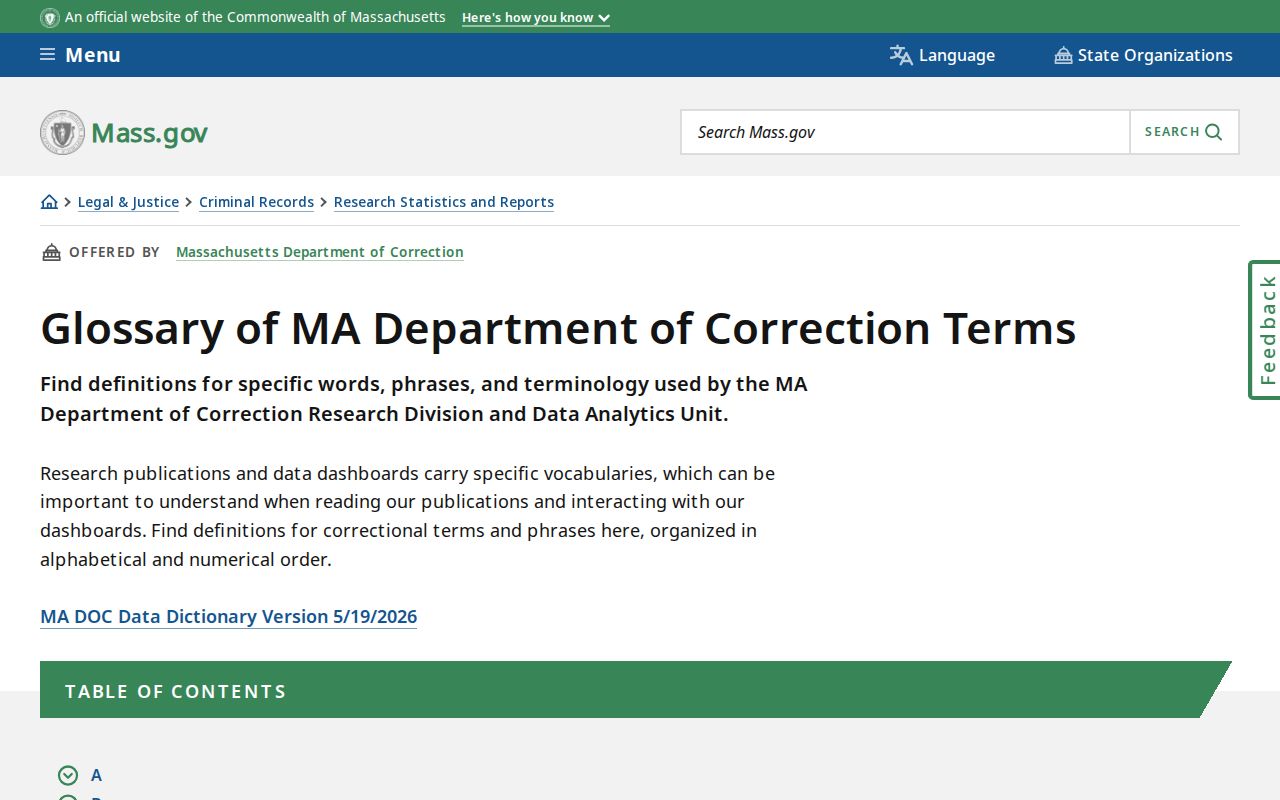
The displayed labels show why “release date” cannot safely stand in for ERD, ERD Max, or actual release from sentence.
Essex County Custody Determines Dates
A pretrial detainee has no sentence-expiration date. Bail, personal recognizance, dismissal, a changed detention order, or disposition may lead to release. Another warrant or hold may prevent community release even after the Essex case changes. The court docket shows legal authority, while the Middleton facility record identifies the ECSD custodian that processed the event.
A sentenced house-of-correction prisoner follows the court's sentence, presentence jail credit, and ECSD's date calculation. For a state-prison sentence, MA DOC maintains the administrative calculation and Certificate of Discharge/Release. A transfer from Middleton to the Lawrence Pre-release and Re-entry Center is not release. Neither is a transfer to MA DOC, Barnstable, federal custody, or immigration custody.
The Essex court record and custody record serve different roles. The judgment fixes the sentence and may award jail credit. Later orders can revise or vacate that result. ECSD or DOC applies the governing calculation to the custody record. If the two sources seem to conflict, compare their dates and ask the custodian whether a later order, credit correction, or second sentence changed the controlling term. Do not choose the earlier date merely because it appears more favorable.
| Status | Best date source | What it establishes |
|---|---|---|
| Pretrial at Middleton | Essex docket plus ECSD release entry | Court authority and actual county processing |
| County sentence | Sentence, jail credit, and ECSD calculation | House-of-correction term and county release |
| MA DOC sentence | DOC calculation and discharge certificate | State sentence dates and actual discharge |
| Federal sentence | BOP locator and federal record | Federal custody date, not Essex custody |
Find Essex County Inmate Release Dates
Begin with the agency that actually holds the person. MA DOC's public locator directs users to VINELink and states that only MA DOC participates in Massachusetts VINE. That route cannot prove a date for someone held only by ECSD. It requires a full first and last name or commitment number and is framed as a current-custody locator, not a permanent historical discharge archive.
- Identify custody. Separate ECSD, MA DOC, federal, immigration, and other-county custody.
- Get the sentence source. Obtain the docket, sentence, minimum and maximum terms, jail credit, and later court orders.
- Use the state locator only for MA DOC. Open the official prison-locator instructions, search by full name or commitment number, and preserve the exact date label.
- For an ECSD sentence, contact the records custodian. Ask for the existing release or date record tied to the booking and sentence. Do not ask ECSD to create a new calculation.
- For a state sentence, request the calculation. Ask MA DOC for the existing sentence-data or date-computation record and Certificate of Discharge/Release.
- Check later changes. Review court orders, parole decisions, warrants, holds, credit adjustments, and transfers.
- Confirm actual release. Match the final date to the custodian's release record rather than treating disappearance from a locator as proof.
The broader Essex County release record process can help identify the correct custodian and distinguish a release from a transfer. A focused request should include full name, booking or commitment number, approximate custody dates, facility, court, and docket number if known.
Note: VINELink can show a live custody change for MA DOC, but a missing result may reflect spelling, scope, or record aging.
Essex County Earned Release Credits
Massachusetts does not use a universal rule that every prisoner serves exactly 85 percent. Former statutory good time was repealed, and the DOC glossary states that statutory good time was eliminated for offenses committed after June 30, 1994. A historical state study found an 85-percent pattern for one past cohort, but that observation is not a current formula. Modern computations depend on the judgment, offense rules, minimum and maximum terms, presentence credit, earned deductions, and the agency's calculation.
Under M.G.L. c. 127, §129B, qualifying presentence confinement is credited unless the court already applied it. Section 129D sets different earned-credit rules for state prison and houses of correction. Qualifying state-prison deductions may reach 7.5 days per program or activity per month, capped at 15 days per month. House-of-correction deductions may reach five days per activity per month, capped at ten days per month.
A qualifying completion can add up to ten days, with a six-month-program condition for the extra house-of-correction award. State prisoners may receive qualifying completion credits up to 80 days per completion, subject to an aggregate cap of 17.5 percent of the maximum term. The statute also caps applicable reductions against the imposed maximum and minimum at 35 percent. Awards depend on satisfactory participation and demonstrated skill, so enrollment alone does not guarantee credit.
The text of section 129D shows the separate limits.
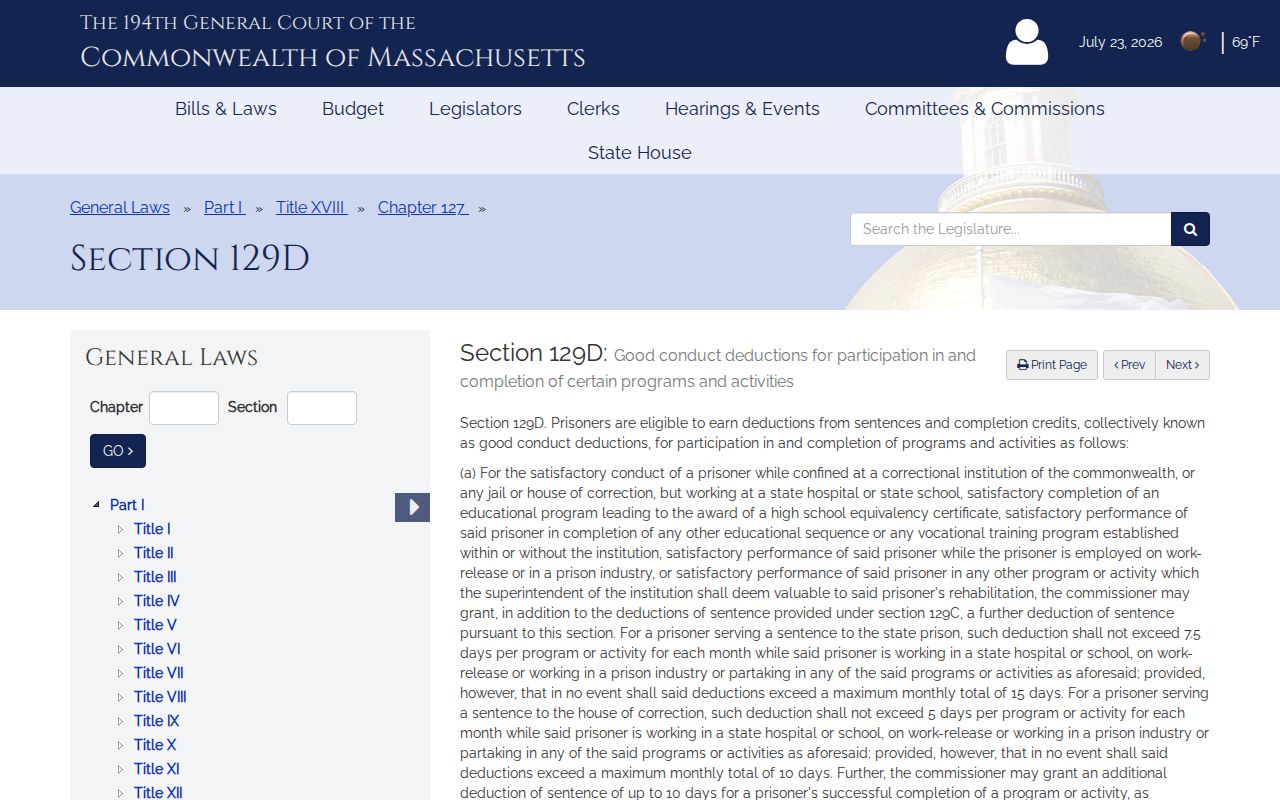
Those distinct rules are why a state-prison date cannot be calculated with the county house-of-correction rate, or vice versa.
Essex County Sentence Restrictions
Credits are only one part of the computation. Habitual offenders sentenced under M.G.L. c. 279, §25(b) are ineligible for probation, parole, work release, furlough, and good-conduct deductions. Mandatory-minimum and offense-specific provisions may impose other limits. Concurrent sentences run together, while consecutive sentences run in sequence, and a correction to that structure can materially alter the controlling date.
Parole eligibility also is not the same as discharge. Under M.G.L. c. 127, §133, ordinary state-prison eligibility relates to the judicial minimum as reduced by eligible section 129D deductions. The Parole Board can deny, postpone, rescind, or later revoke parole. A grant may require an approved release plan and permit execution before physical release.
No public percentage calculator can account for all those facts. Use the actual sentencing dates, offense restrictions, jail credits, concurrent or consecutive terms, holds, and official calculation.
Why Essex County Release Dates Change
A projected date reflects the record at the time it is calculated. Later credits or corrections can change it. Some events move the date itself, while others change only the person's destination. A detainer, for example, may leave the sentence end intact but result in transfer to another agency instead of community release.
| Cause | Possible effect |
|---|---|
| Earned or completion credit posts | Can advance an eligible date within statutory limits |
| Credit loss or ineligibility | Can move the estimate later |
| Corrected presentence credit | Changes the sentence calculation |
| Concurrent or consecutive correction | Can change the controlling date materially |
| Parole grant, rescission, or revocation | Changes the release or return-to-custody path |
| Vacated or revised sentence | Can replace the prior computation |
| Warrant or detainer | May change destination without changing sentence end |
| Transfer | Ends one status while custody continues elsewhere |
Ask for the latest dated calculation. A screenshot or paper from an earlier stage may no longer reflect the active sentence structure.
Weekend Essex County Sentence Release
Massachusetts law creates a precise exception for qualifying sentence expirations. Under M.G.L. c. 127, §150, when a term expires on Saturday, Sunday, or a legal holiday, the prisoner is discharged on the preceding day. This rule does not govern every bail release, parole event, transfer, or emergency court order.
Intermittent weekend sentences follow a separate rule under M.G.L. c. 279, §6A. Qualifying terms ordinarily require Friday reporting by 6 p.m. and Monday release at 7 a.m., with Tuesday release when Monday is a holiday, until the imposed time is served. That is not the same as moving an ordinary expiration to the prior business day.
The official weekend and holiday provision documents the narrow adjustment.
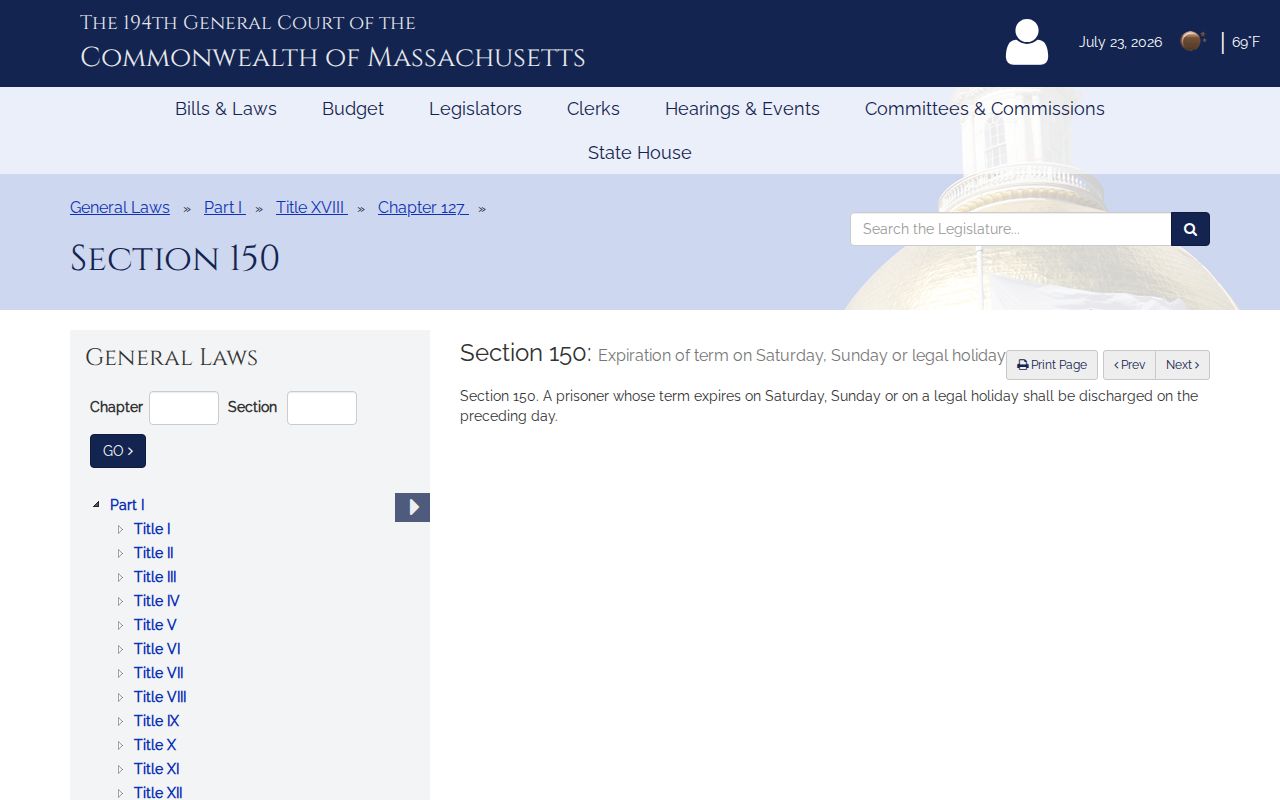
The statute supports a date adjustment only when its sentence-expiration condition applies. Confirm that condition with the custodian.
Note: A Friday discharge under section 150 is a sentence rule, not evidence that all Essex County releases occur before weekends.
Confirm Essex County Actual Release
For ECSD custody, follow the sheriff's public-record request route and seek the nonexempt portions of the existing OMS release history. Useful fields include the booking number, admission date, releasing facility, actual release date and time, release type, and receiving authority. Pair that record with the court judgment and docket. The Essex courthouse locator identifies the proper clerk. For MA DOC, request the date-computation record and Certificate of Discharge/Release from the DOC Records Access Officer.
MA DOC procedure uses a release module and Central Office Date Computation Unit review before the discharge certificate issues. Staff update earned-credit calculations before final approval. That certificate is better evidence than a disappeared VINELink result. A release alert can be useful, but it should be confirmed because source updates may lag or may describe a transfer.
Keep the source's exact date label, the date the record was checked, and the agency name. Those three details prevent an estimate from being reported as an observed Essex County release.
Massachusetts public-record rules permit a request for existing records, not a demand that the agency create a fresh forecast. Ask ECSD for the public portions of its existing booking, sentence, and release fields. Ask MA DOC for its current date-computation record, release order, and discharge certificate. The request can exclude medical, victim, private-identifier, and security-sensitive material while still seeking the dates and release type needed for confirmation.
When a release date has passed, check the next status rather than assuming a community return. The receiving-agency field, warrant history, parole record, and court docket can reveal continued lawful custody or supervision. That final check is crucial for an Essex County detainee who moved from Middleton to a state, county, federal, or immigration authority.