
Lawrence Release Versus Transfer
The Essex County Pre-release and Re-entry Center is a lower-security ECSD site in Lawrence. It receives selected people who are approaching sentence end after progression from Middleton. Classes, programs, work assignments, community service, work release, and electronic monitoring can allow more movement than a medium-security jail. None of those features alone proves discharge. The person may remain in sheriff custody or under another restrictive legal status while outside the building for an approved purpose.
Read the sequence, not just the location. A Middleton departure followed by admission to Lawrence is an internal transfer. A final ECSD entry may later show sentence expiration, parole, probation, court release, another agency, or another release type. If the person enters the community, the court judgment and supervising office clarify what follows. If the person goes to MA DOC, another county, federal custody, or a warrant holder, physical confinement continues. “Pre-release” describes the center’s role. It is not an official result saying that each resident has been released.
| Status | What it means at Lawrence | Proof to seek |
|---|---|---|
| Step-down from Middleton | ECSD custody continues at a lower-security site | Internal transfer and placement history |
| Work or community assignment | Authorized activity while legal status continues | Program status plus final OMS event |
| Electronic monitoring | Outside placement may still be restrictive | Court or ECSD terms and final discharge |
| Community discharge | ECSD custody ends, perhaps with supervision | OMS release entry, docket, supervising agency |
Verify a Lawrence Center Release
ECSD does not offer a verified public roster or released-person feed. Start with the actual custodian and request affirmative evidence. The Offender Management System, or OMS, is ECSD’s booking and release record system. Its release date and release type identify the final sheriff event more clearly than a person’s absence from Middleton, the Lawrence building, or a program schedule.
- Collect the full name, approximate ECSD custody period, Lawrence placement dates, and booking number if known.
- Ask ECSD for the final OMS release date, release type, releasing facility, and receiving agency or supervision destination if maintained.
- Check the originating court docket by exact docket number for sentence, presentence custody time, probation, parole-related entries, warrants, and later orders.
- If ECSD lists another custodian, search that agency. MA DOC’s locator covers MA DOC, not a person held only by the sheriff.
- If the release begins probation or parole, verify the order or supervising office rather than calling it an unconditional discharge.
The Essex County released inmate search path explains how county, state, federal, and immigration records fit together. Use it when the Lawrence record names a destination outside ECSD.
Lawrence Center Release Records
Submit a focused request through the ECSD Records Access Officer. Ask for existing public and nonexempt portions of the OMS booking and release history for the named person and a narrow date range. Request the booking number, admission date, Lawrence placement, releasing facility, actual release date and time, release type, transfer destination, receiving agency, and public court or mittimus reference to the extent maintained. A mittimus is the court’s commitment paper.
Request electronic delivery and avoid asking ECSD to create a new report. Massachusetts law generally calls for production or a written response within ten business days, though a lawful exemption, fee estimate, or production plan may apply. Privacy, medical, victim, investigatory, sealed, juvenile, and institutional-security details can be redacted. The release date and type may still be segregable from protected data.
Lawrence and ECSD Contacts
Essex County Pre-release and Re-entry Center
165 Marston Street
Lawrence, MA 01841
978-750-1900 ext. 4309
Records Access Officer
Gretchen Grosky
P.O. Box 807, Middleton, MA 01949
978-750-1900 ext. 3361
ggrosky@essexsheriffma.org
The direct Lawrence extension routes facility questions. The central RAO is the proper written channel for an ECSD release or discharge record.
Lawrence Release Program Profile
ECSD’s 2024 annual report lists an average daily population of 103 at the Lawrence center, including nine people counted in the Electronic Monitoring Program. Those figures are annual operating measures, not a live count. They also show why “outside the building” and “released from custody” are not equal. Electronic monitoring can be part of a controlled status rather than final discharge.
The official source depicts the Lawrence site’s lower-security and step-down function. Open the ECSD Pre-release and Re-entry Center page before viewing the captured page.
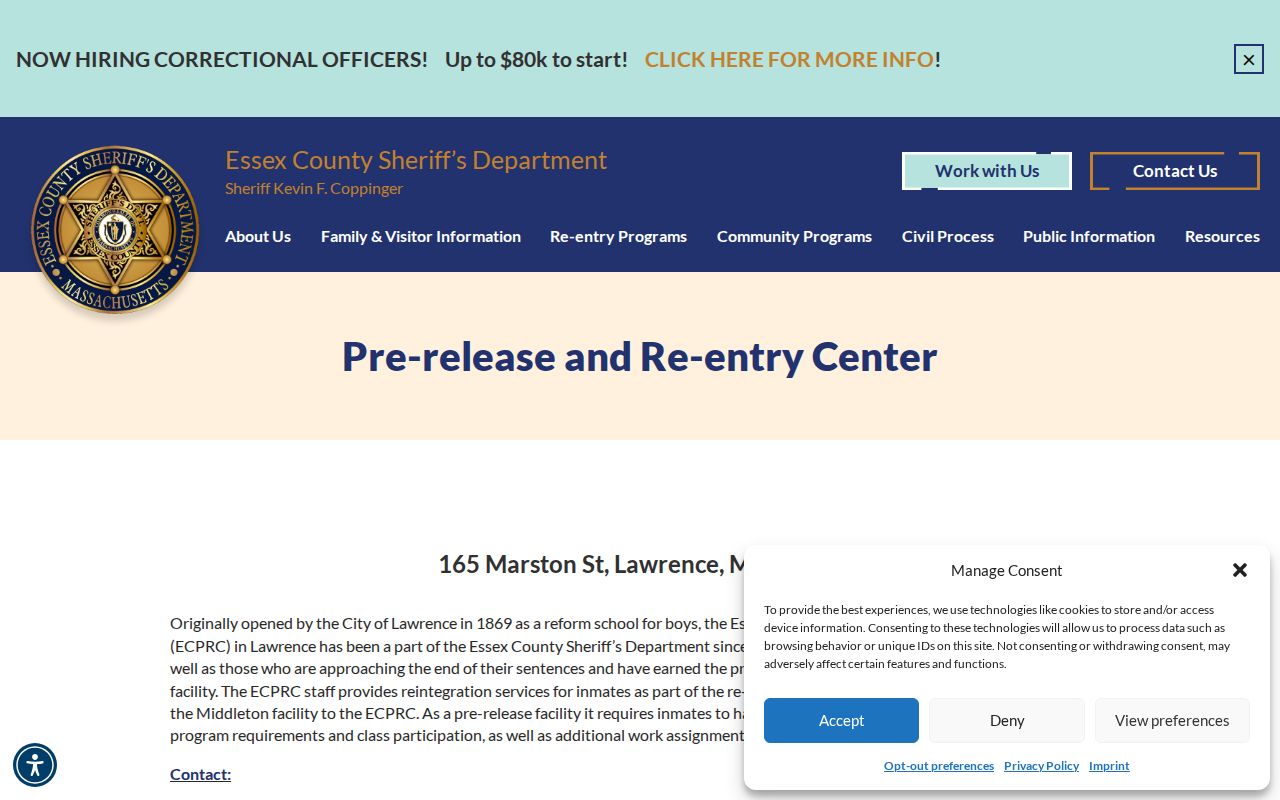
The image supports the facility identity and role. It is not a roster, and it cannot confirm one person’s final release.
Lawrence Release Preparation
The 2024 report says case managers helped eligible people obtain Massachusetts identification, birth certificates, and Social Security cards. It also documents help arranging medical or counseling appointments and coordination with parole or probation. Transportation was provided to parole when needed, to court for required probation GPS reporting, and to programs in specified pretrial-diversion cases. These are concrete release-preparation functions. They must not be expanded into a promise that every resident receives the same services or a ride to any chosen address.
For a particular person, ask what final ECSD event occurred and which agency took over next. Parole is executive supervision after release by the Massachusetts Parole Board. Probation is court-ordered supervision. Electronic monitoring is a tool that may attach to custody, pretrial conditions, or supervision depending on the order. Program participation can help explain the transition plan, but it does not replace the official release entry.
Documents created during preparation can still help reconcile the timeline. An appointment or identification referral may show that discharge planning was underway, yet it does not set the legal release date. Transportation to a parole office can support the next-step plan, but the Parole Board record confirms supervision. A required trip to court for GPS reporting points back to the probation order. Use these records as context and keep the final OMS event at the center of the release finding.
- Step-down
- A move to a less restrictive ECSD setting while custody continues.
- Work release
- Authorized work outside the facility under set conditions, not final discharge by itself.
- Discharge
- The formal end of the relevant custody or sentence status.
- Receiving agency
- The authority that takes custody after ECSD ends its part.
Lawrence Release Custody Boundaries
ECSD’s public statement applying the Massachusetts Lunn decision says state officers cannot keep someone beyond an otherwise lawful release point solely on a federal civil immigration detainer. This rule does not turn Lawrence into an ICE facility. Nor does it guarantee that the person enters the community. Federal officers can act separately, and a different warrant or lawful custody basis can change the destination.
When the final OMS event points outside ECSD, identify that authority by name. Search ICE separately if immigration custody is at issue, MA DOC for a state-prison transfer, or the named sheriff for another county placement. A Lawrence release record establishes the end or change of ECSD status. The receiving source establishes what happened next. Keeping both entries distinct avoids the common mistake of treating every interagency handoff as freedom.
Lawrence Center Release History
The Lawrence property began as a boys’ reform school in 1869 and became part of ECSD in 1976. Its modern role is not that of an interchangeable satellite jail. It is a lower-security step-down setting for selected people nearing sentence end, with more responsibility tied to programs, classes, work, and community activity. The long local history helps explain why the building’s name and role have changed while custody records remain the key source.
That distinction has practical value. Someone who leaves Middleton for Lawrence has changed sites but has not yet reached final discharge. A later move to community supervision also differs from an end of all legal obligations. Read the OMS events in order and match the last one to the court and supervising agency. The specific Lawrence history supplies context; the dated release entry supplies proof.
The order of entries is especially useful for a person who moved through several ECSD settings. Record the Middleton departure, Lawrence admission, any electronic monitoring status, and the final coded event. If the sequence ends with a receiving agency, the search must continue there. If it ends with probation or parole, the next record belongs to the court or Parole Board. If it shows sentence completion without a receiving authority, ask whether ECSD recorded any other active legal status. A complete sequence prevents the lower-security placement from being mistaken for the final event.
Annual figures also need this same care. The Lawrence average daily population and Electronic Monitoring Program count describe operations during 2024. They do not identify a particular person or establish a release total. Use them to understand why status can exist both inside and outside the building, then return to the individual OMS and court records for proof.
Note: The Lawrence center’s pre-release name describes preparation and custody level, not a public finding that a named person is free.
Public Record Search
Sponsored Results